How to tie shoelaces when you can't bend or reach
Quick answer: Stop tying laces for now: wear slip-ons with a back, or leave the laces tied loose, and sit down to guide your heel in with a long handle. Elastic no-tie laces turn shoes you already like into slip-ons.
A bow needs both hands working down at your instep, and getting your heel in needs the back of the shoe held open at floor level. When your hips, your back or a pregnancy bump stop you folding that far, both halves of the job are out of reach.
Try this first (no purchase)
- Tie them once, at table height. Keep your shoes on a shelf or chair seat instead of the closet floor, or ask someone to hand them up. Loosen the laces at the table, retie them in a double knot with enough slack for your foot to slide in, and leave them tied from then on.
- Wear the slip-ons you already own. Loafers, clogs with a heel strap and sneakers with a wide opening all go on without tying. Stick to shoes with a closed back, because a heel that slips out means another trip down to the floor.
- Use a long wooden spoon as a shoehorn. Set the back of the bowl inside the heel of the shoe, hold the handle, and push your foot down along it. Pick one with a smooth, unchipped bowl. It's shorter than a real long shoehorn, so it only helps if you can reach about halfway down your shin.
- Sit down and line the shoe up without bending. Sit on a firm chair with arms and nudge the shoe into place with your other foot or the tip of a cane you already use. Wriggling into a shoe while standing on one leg is where people lose their balance.
- Raise your foot only if your team says it's fine. A low step or footstool brings the laces closer, but it also bends the hip further. After joint or back surgery, check with your team before you use one.
What actually helps
We may earn a commission when you buy through these links. It never decides what we list — see how we choose. Not a fit? Amazon takes most items back within 30 days; check the listing, since some personal-care items can't be returned.
Laces you never tie

Our pick
RJ-Sport elastic no-tie laces with lock
Elastic no-tie laces · how to choose an elastic no-tie laces
$7.99 price as of Sep 27, 2026 at 4:47 pm ET
Check price on Amazon (opens new tab)- Why it works
- Elastic laces with a lock turn sneakers into slip-ons: one reviewer slides a foot in without bending down, which is the point when your feet are out of reach.
- Who it won't suit
- Threading them and setting the lock takes two hands and some fiddling, so someone else may need to fit them; they are made for sneakers, not dress shoes.
What reviewers report
Reviewers say shoes go on without bending down to tie anything, and one of them is seventy-five, with arthritis in both hands and a brace on each wrist. — Our summary of customer reviews on Amazon · read the reviews (opens new tab)
Getting shoes on

Our pick
ZOMAKE 16.5" metal long-handled shoehorn
Long-handled shoehorn
$9.99 price as of Sep 27, 2026 at 4:47 pm ET
Check price on Amazon (opens new tab)- Why it works
- Slide your heel down the 16.5-inch metal blade from a sitting or standing position, so shoes with tied or elastic laces go on without reaching your feet.
- Who it won't suit
- It gets your heel in but can't tighten or tie laces, so pair it with slip-ons or no-tie laces; reviewers bought it mostly for back problems.
What reviewers report
Reviewers with back problems say shoes go on without bending down at all, which is the whole reason they went looking for a longer handle. — Our summary of customer reviews on Amazon · read the reviews (opens new tab)

Cheaper option
Phantawell 35.5" shoehorn and dressing stick
Long-handled shoehorn
$8.32 price as of Sep 27, 2026 at 4:47 pm ET
Check price on Amazon (opens new tab)- Why it works
- At 35.5 inches it lets you guide your heel into boots and shoes while sitting upright; one reviewer says it is strong enough for boots and long enough to skip bending.
- Who it won't suit
- It gets shoes on but can't tie them, so pair it with slip-ons or no-tie laces; it assembles from parts and can be set to 22.5 inches.
What reviewers report
Reviewers who cannot bend after back surgery say the length is what matters: at thirty-five inches it reaches boots, and the hook on the other end also pulls socks off. — Our summary of customer reviews on Amazon · read the reviews (opens new tab)
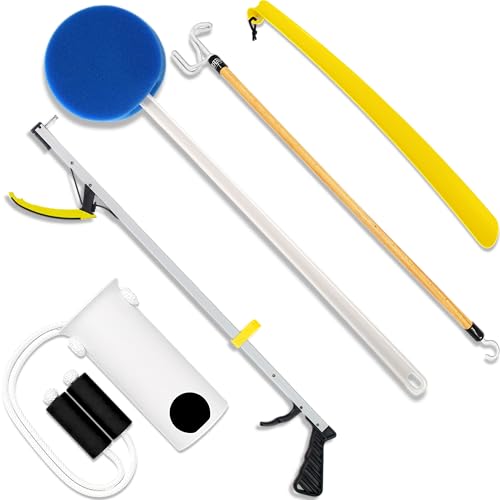
If you need the whole kit
RMS 5-piece hip & knee kit with 26" reacher
Hip kit
$39.99 price as of Sep 27, 2026 at 4:47 pm ET
Check price on Amazon (opens new tab)- Why it works
- One box covers the first weeks after a hip replacement: a 26" reacher, a sock aid, a 28" dressing stick, a 22" sponge and a 24" shoehorn. One reviewer ordered it on a hospital therapist's advice.
- Who it won't suit
- You pay for five tools even if you only need the sock aid and a shoehorn, and one owner found part of it a bit flimsy, though it still worked well sitting down.
What reviewers report
Reviewers bought the kit for hip replacement recovery, several on a physical therapist's advice, and say the reacher, sock glider and shoehorn were still in use months afterwards. One found the dressing stick flimsy. — Our summary of customer reviews on Amazon · read the reviews (opens new tab)
What not to buy for tying shoes when you can't bend or reach
- Backless slides and mules — they go on without bending, but nothing holds your heel, so they come off on stairs and curbs and you have to bend to put them back on.
- A short pocket shoehorn — it helps the heel slide in, but you still have to fold all the way down to hold it in place.
- Boots that zip at the inner ankle — the zipper pull starts at your ankle bone, so you're reaching for your foot every morning and every night.
Buying this for someone else?
- Ask what movement precautions their surgical or care team gave, and for how long. Those decide how high a toilet seat or chair needs to be, and whether some positions are off limits.
- Measure before ordering: their height, the chair or bed they'll dress on, and the toilet. Reachers, shoehorns and raised seats come in several lengths and heights, and the wrong one ends up in a closet.
- Match the spend to how long they'll need it. For a few weeks of recovery, a basic version or a loan-closet item is fine; for a condition that's here to stay, a sturdier one is worth it.
- Check which hands they can use. A sock aid needs two hands to pull the cords evenly, and a reacher needs a grip firm enough to squeeze the trigger many times a day.
- Plan where each tool will live. A reacher only helps if it's next to the chair, the bed or the shower when it's needed, so pick a hook or a spot for each one.