How to cut food with one hand
Quick answer: Anchor the board and give the food a flat side before you cut, so neither can move when you press down. Then rock a sharp chef's knife through the food instead of sawing, or switch to kitchen scissors.
Not quite your situation? Cutting food with a weak grip or see every reason cutting food gets hard.
Cutting usually splits the work: one hand pins the food while the other drives the knife. With only the knife hand, a potato rolls away from the blade, bread slides as you saw, and the board itself can skate across the counter each time you push down. The less the food moves, the safer and neater the cut.
Try this first (no purchase)
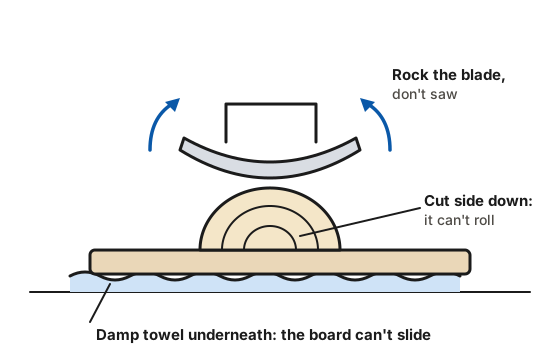
- Stop the board sliding. Wet a thin dish towel or two sheets of paper towel, squash the extra water out by pressing them flat on the counter with your palm, and set the board on top. Push hard on one corner of the board; if it shifts, add more damp cloth.
- Cut round food onto a flat face. Take a thin slice off one side of an onion, potato or apple, then roll it onto that flat side so it sits still. For that first slice, stand a heavy pot on the far side of the board and push the food up against it, so it has something to lean on as the blade goes in.
- Rock the knife instead of sawing. Keep the tip of a chef's knife on the board and press the handle down and slightly forward. Rocking pushes the food into the board rather than away from you, and a sharp blade needs less force, so it's less likely to skid. If anything shifts mid-cut, stop, put the knife down and reset; never steady food with fingers poking out of a cast or sling.
- Use kitchen scissors for the awkward things. Herbs, green onions, bacon, chicken, pizza, tortillas and cooked pasta all cut easily with scissors in one hand, often straight into the pan or over the plate. Wash them in hot, soapy water after raw meat, as you would a knife.
- Buy it already cut. Frozen chopped onions and peppers, stir-fry mixes, pre-sliced mushrooms, shredded cheese and sliced bread cost a little more but take the knife out of the job entirely. For a few weeks in a cast, this may be all you need.
What actually helps
We may earn a commission when you buy through these links. It never decides what we list — see how we choose. Not a fit? Amazon takes most items back within 30 days; check the listing, since some personal-care items can't be returned.
Holding the food still

Our pick
Adaptive one-handed cutting board with steel spikes
Adaptive cutting board
$44.99 price as of Sep 27, 2026 at 4:47 pm ET
Check price on Amazon (opens new tab)- Why it works
- Ten stainless spikes hold food while you cut, a raised back fence stops it sliding off, and silicone feet keep the board still; bought for people with one side weakened by a stroke.
- Who it won't suit
- One buyer felt it didn't look adaptive enough to use with one hand, so check the spike height and the fence in the photos before you order.
What reviewers report
Buyers who had a stroke, and people cutting with one working hand, report that the spikes and the raised edge do the holding for them. One reviewer disagreed and felt the board was not adaptive enough for single-handed use. — Our summary of customer reviews on Amazon · read the reviews (opens new tab)

Cheaper option
One-handed cutting board with spikes, bread stops and grater
Adaptive cutting board
$35.99 price as of Sep 27, 2026 at 4:47 pm ET
Check price on Amazon (opens new tab)- Why it works
- Steel spikes with a wooden cover, bread stops, a rubber band attachment and a grater with 5 blades on a non-slip board; one reviewer with a dominant arm in a sling found it met a real need.
- Who it won't suit
- One reviewer who had a stroke and cooks with one hand says it really didn't help them, so it may suit a temporary injury better than long-term one-handed cooking.
What reviewers report
Reviews are split. Someone with a dominant arm in a sling found it addressed a real need, while a stroke survivor who works with one hand reported that it did not solve the problem. — Our summary of customer reviews on Amazon · read the reviews (opens new tab)
Cutting

Our pick
KAYCROWN ulu rocker knife with stand
Rocker knife · how to choose a rocker knife
$13.99 price as of Sep 27, 2026 at 4:47 pm ET
Check price on Amazon (opens new tab)- Why it works
- A crescent-shaped blade you rock through food, so nothing has to be held still with a second hand; a reviewer's mother who survived a stroke uses it daily.
- Who it won't suit
- Not for a household with small children or anyone unsteady on their feet: it is a large open blade stored on a stand, not in a cover. Reviewers used it one-handed, not with a weak grip.
What reviewers report
Two reviews, both from people buying for someone else: a mother who had a stroke and uses it daily, and a friend whose shoulder was immobilized after surgery. — Our summary of customer reviews on Amazon · read the reviews (opens new tab)

Cheaper option
YPCBYNBS T-Grip Rocker Knife,Adaptive Knife with Rocking Grip for…
Rocker knife · how to choose a rocker knife
$9.49 price as of Sep 27, 2026 at 4:47 pm ET
Check price on Amazon (opens new tab)- Why it works
- The T-shaped handle sits inside a closed fist, so the arm rocks the 4-inch blade through food instead of the wrist sawing, and a single hand completes the cut.
- Who it won't suit
- Buyers with severe arthritis called the handle uncomfortable to hold for long, and one found the blade duller on arrival than the listing suggests.
What reviewers report
Reviewers cutting with one hand after a stroke, a cast or torn tendons say the rocking blade works for them. Those with severe arthritis are split: one found the handle uncomfortable and the blade less sharp than expected. — Our summary of customer reviews on Amazon · read the reviews (opens new tab)
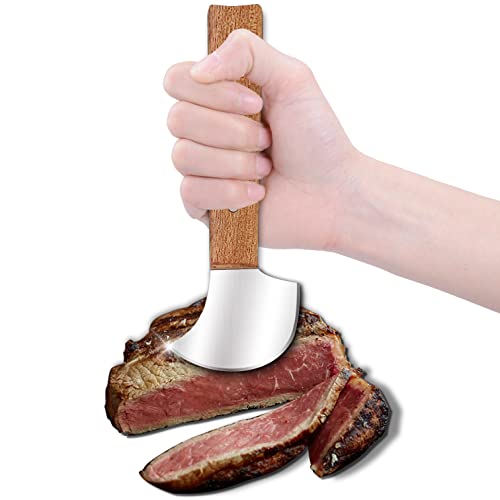
Small enough for the table
Fstcrt rocker knife with vertical wooden handle
Rocker knife · how to choose a rocker knife
$19.99 price as of Sep 27, 2026 at 4:47 pm ET
Check price on Amazon (opens new tab)- Why it works
- A small curved blade under a vertical wooden handle: you press down and rock, so food doesn't need holding with a fork; reviewers use it one-handed after a stroke and shoulder surgery.
- Who it won't suit
- It is compact (6.3 inches long, about 100 grams), so large roasts and tough crusts take a while, and the curved edge is sharp when you wash it.
What reviewers report
Reviewers cutting with one hand after a stroke or shoulder surgery, and others with severe arthritis, say the rocking blade does what a fork and knife used to need two hands for. — Our summary of customer reviews on Amazon · read the reviews (opens new tab)
What not to buy for cutting food with one hand
- Mandolines and V-slicers — one hand pushes the food across the blade while the other holds the frame still. One-handed, the frame slides, and a slip on that blade means a serious cut.
- Pull-cord mini choppers — one hand holds the bowl down while the other yanks the cord, so the bowl tips or skids as you pull. A chopper you push down on with your palm is the version that works with one hand.
- Suction-foot boards on a textured counter — suction feet need a smooth, sealed surface. On wood, tile grout or textured laminate they release as soon as you lean on the board, and a damp towel underneath grips better.
Buying this for someone else?
- Which hand is free, and is it their writing hand? Someone left with their non-dominant hand will find fine tasks harder than you might guess. Scissors and some knives are made for right or left hands, so check before ordering.
- Weeks, or for good? For a cast or sling, cheap and portable makes sense. After a stroke, an amputation or with a limb difference, tools that mount to a counter or cabinet are worth the setup.
- Where it would go. Mounted openers need a flat cabinet underside and screws, which renters may not be allowed to fit. Suction tools need a smooth counter. Look at the kitchen or bathroom before you order.
- What's already in the drawer. Ask what they've tried and whether an occupational therapist has already given them something. Most people have a gadget that didn't work, and knowing why it failed is the most useful thing you can learn.