How to cut food with a weak grip
Quick answer: Thicken the knife handle, keep the blade sharp, and press down with your palm and body weight instead of sawing with a tight grip. A rocker knife or a knife with a built-up handle makes that setup permanent.
Not quite your situation? Cutting food with one hand or see every reason cutting food gets hard.
Cutting asks your hand to hold a narrow handle firmly enough that it doesn't twist, while also driving the blade down through the food. A standard knife handle is so slim that your fingers must curl nearly shut around it, and every sawing stroke means tightening that grip again. A dull edge or a hard food like raw squash multiplies the push needed.
Try this first (no purchase)
- Build up the handle. Wrap a washcloth or a thin dish towel tightly around the knife handle and hold it with two or three rubber bands, or slide a foam hair curler, clip removed, over it. Keep the wrap well back from the blade and check that it can't slide forward before you start cutting.
- Use your sharpest knife. A sharp edge sinks in with light pressure. A dull one makes you lean and clench, and it is more likely to skid off a tomato skin or an onion. If a family member has a sharpener or honing steel, ask them to touch up the one knife you use most.
- Rock instead of saw. With a long knife, keep the tip on the board and lower the handle through the food in one movement, like working a paper cutter. Rest your palm on top of the handle and let your arm and body weight do the pushing, which is easier at a kitchen table than at a high counter.
- Soften it or skip the cut. Potatoes, carrots and squash slice far more easily once cooked, so roast or microwave them whole or halved, let them cool enough to handle, then cut. Pierce the skin a few times before microwaving. Frozen chopped onions and peppers, and meat sliced for you at the deli or butcher counter, take the hardest cuts off your list.
- Reach for a pizza wheel if you have one. It rolls through pancakes, tortillas, toast, omelets and cooked pasta with a push from the arm, and its handle is usually thicker than a knife's.
What actually helps
We may earn a commission when you buy through these links. It never decides what we list — see how we choose. Not a fit? Amazon takes most items back within 30 days; check the listing, since some personal-care items can't be returned.

Our pick
Peta Easi-Grip right-angle carving knife
Easy-grip kitchen knife
$23.95 price as of Sep 27, 2026 at 4:47 pm ET
Check price on Amazon (opens new tab)- Why it works
- The handle sits at 90° to the blade, so you press down with a straight wrist and your forearm instead of gripping and sawing; bought for arthritis and for Parkinson's.
- Who it won't suit
- Not for you if you cook with one hand: the blade still needs the food held steady. It is sold as a bread and carving knife, so hard vegetables are not its job.
What reviewers report
The reviews are short. Buyers name Parkinson's and a partner's arthritis as the reason for choosing it, and both say the angled handle works for them. — Our summary of customer reviews on Amazon · read the reviews (opens new tab)

Cheaper option
YPCBYNBS T-Grip Rocker Knife,Adaptive Knife with Rocking Grip for…
Rocker knife · how to choose a rocker knife
$9.49 price as of Sep 27, 2026 at 4:47 pm ET
Check price on Amazon (opens new tab)- Why it works
- The T-shaped handle sits inside a closed fist, so the arm rocks the 4-inch blade through food instead of the wrist sawing, and a single hand completes the cut.
- Who it won't suit
- Buyers with severe arthritis called the handle uncomfortable to hold for long, and one found the blade duller on arrival than the listing suggests.
What reviewers report
Reviewers cutting with one hand after a stroke, a cast or torn tendons say the rocking blade works for them. Those with severe arthritis are split: one found the handle uncomfortable and the blade less sharp than expected. — Our summary of customer reviews on Amazon · read the reviews (opens new tab)
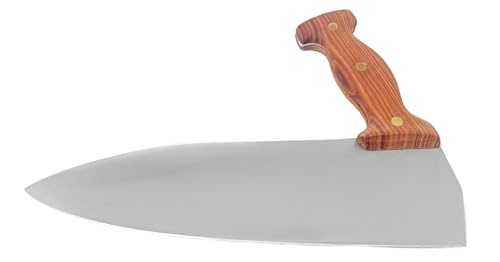
A full-size chef's knife
Wristrait vertical-handle chef knife, 9.5"
Easy-grip kitchen knife
$39.99 price as of Sep 27, 2026 at 4:47 pm ET
Check price on Amazon (opens new tab)- Why it works
- A full-size 9.5-inch chef's blade with a vertical wooden handle, so you push down with a straight wrist; reviewers use it for arthritis and tendonitis.
- Who it won't suit
- At 9.9 oz it is heavy, which helps it cut but may be too much to lift for a very weak hand, and it costs more than the plastic angled knives.
What reviewers report
Two reviewers bought it for arthritis, one of them also with tendonitis, and say it works for them. There is not much more detail in the reviews than that. — Our summary of customer reviews on Amazon · read the reviews (opens new tab)
3 more options follow below.
More options that also work (3)
These fit too, but we'd try the picks above first.

ABLE-T serrated right-angle knife
Easy-grip kitchen knife
$14.99 price as of Sep 27, 2026 at 4:47 pm ET
- FSA/HSA eligible
- Why it works
- Designed by an occupational therapist, the angled grip keeps your wrist straight while a 6-inch serrated blade cuts; reviewers with arthritis and carpal tunnel cut food more easily.
- Who it won't suit
- The serrated blade suits steak, bread and tomatoes; for chopping vegetables the maker sells a separate flat blade, and this is one knife, not a set.
What reviewers report
Reviewers with arthritis in their hands, several with carpal tunnel as well, say that cutting food became easier once they switched to this handle. — Our summary of customer reviews on Amazon · read the reviews (opens new tab)

Right-angle knife 2-pack, serrated and chopping
Easy-grip kitchen knife
Currently unavailable on Amazon
Check price on Amazon (opens new tab)- Why it works
- Two L-shaped knives, one serrated and one flat for chopping, with 6-inch blades; one reviewer bought them on a hand therapist's advice for osteoarthritis in both thumbs.
- Who it won't suit
- Not for a one-hand kitchen: both knives still need the food held. It is also two knives at once, which is more than a single cook needs.
What reviewers report
Reviewers with arthritic hands say chopping takes less effort than with a straight knife, and one bought the pair on a hand therapist's advice for osteoarthritis in both thumbs. — Our summary of customer reviews on Amazon · read the reviews (opens new tab)
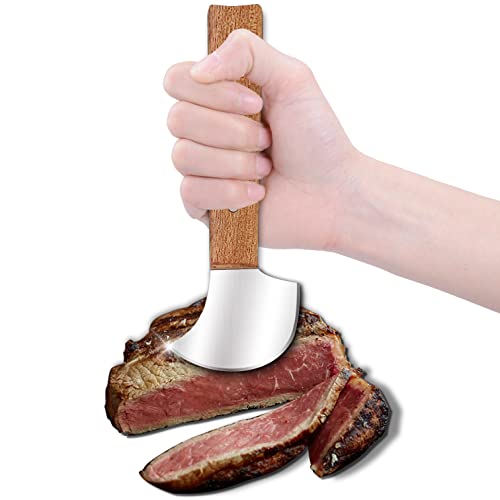
Fstcrt rocker knife with vertical wooden handle
Rocker knife · how to choose a rocker knife
$19.99 price as of Sep 27, 2026 at 4:47 pm ET
Check price on Amazon (opens new tab)- Why it works
- A small curved blade under a vertical wooden handle: you press down and rock, so food doesn't need holding with a fork; reviewers use it one-handed after a stroke and shoulder surgery.
- Who it won't suit
- It is compact (6.3 inches long, about 100 grams), so large roasts and tough crusts take a while, and the curved edge is sharp when you wash it.
What reviewers report
Reviewers cutting with one hand after a stroke or shoulder surgery, and others with severe arthritis, say the rocking blade does what a fork and knife used to need two hands for. — Our summary of customer reviews on Amazon · read the reviews (opens new tab)
What not to buy for cutting food with a weak grip
- Standard kitchen shears — you squeeze the blades shut and then pull the small finger holes open again for every snip, and the metal rings press into stiff fingers.
- Mandoline slicers — the food guard is held by a small knob, and if your grip gives out partway through a stroke, your fingertips are right next to a very sharp blade.
Buying this for someone else?
Check these before you order:
- How far their fingers close. Watch them hold a mug or a hairbrush. If the fingers don't wrap all the way round, a thicker handle matters more than any other feature.
- Which movement is the problem. Twisting (lids, keys, taps), squeezing (scissors, spray bottles) and pinching (ring pulls, pill caps) call for different tools. Ask which jobs they put off, not only which ones hurt.
- How much weight is comfortable. Something that feels light in your hand can be too heavy for them over a whole meal or a page of writing. Compare the listed weight with a tool they already use every day.
- Left or right hand. Many can openers, scissors and some knives are made for right-handed use.
- What's already in the drawer. Ask what they have tried and why it didn't stick, so you don't buy the same thing twice.