Rocker knife: what it is, how to choose, and 3 that work
A rocker knife has a curved blade that cuts when you press down and rock it from end to end, so you don't need a fork to hold the food still. The downward pressure pins the food to the plate, which is why one hand is enough for most everyday cutting. You'll also see it called a rocking knife or a one-handed knife, and the version with the handle above the blade is often sold as an ulu.
Also sold as: rocking knife, one-handed knife, ulu knife or rocker cutter.
How to choose a rocker knife (rocking knife, one-handed knife)
The rocking motion is the same on every model. Where your hand sits and how sharp the edge is vary a lot, and those two things decide whether it works for you.
- Handle position. Table rocker knives have a straight handle, held like a normal knife, and are made for cutting food on your plate. Upright or T-shaped handles sit directly above the blade, so you push down with your palm and the weight of your arm rather than squeezing with your fingers. With a weak grip, the upright style usually takes less effort; if you'd rather have something that looks like ordinary cutlery at the table, go straight.
- Handle thickness. A handle at least 32 mm (about 1¼ in) thick means your fingers don't need to close fully around it. A thin metal handle is fine if the only issue is using one hand. When grip is the problem, a thick, soft or textured handle matters more than the blade.
- Edge. Rocker knives range from fairly blunt to properly sharp. A blunt edge is safer to handle but struggles with meat, crusts and firm vegetables, and you end up pressing harder. If you mostly cut meat, choose one described as having a sharp stainless steel blade, and treat it with the same care as a kitchen knife.
- Blade size. A short blade, about the width of your palm, is easier to steer on a plate. A longer blade with a deeper curve covers more food per rock and suits a cutting board, but needs room to swing.
- Knife and fork in one. Some models add fork tines at the tip, so you can cut a piece and pick it up without putting one tool down for another.
Who should skip it. A table rocker knife isn't built for raw squash, whole carrots or anything else hard, and it squashes soft bread instead of slicing it. Round food like cherry tomatoes and sausages rolls away from a curved blade unless something holds it, such as the spikes on an adaptive cutting board. A two-handled mezzaluna rocks the same way but needs both hands, so it's no help if you're working with one.
What the numbers mean
- Handle thickness
- A handle at least 32 mm thick means your fingers don't need to close fully to hold it, which leaves more strength for pressing down.
- Handle style
- A handle above the blade lets you press down with your palm and arm; a straight handle is held like ordinary cutlery and feels more natural at the table.
- Blade length
- A short blade is easier to steer on a plate; a longer one covers a sandwich or a pizza slice in fewer rocks.
3 rocker knives that work
We may earn a commission when you buy through these links. It never decides what we list — see how we choose.
| Model | Role | Price | Link |
|---|---|---|---|
| Fstcrt rocker knife with vertical wooden handle | Our pick | $19.99 as of Sep 27, 2026 at 4:47 pm ET |
See on Amazon (opens new tab) |
| KAYCROWN ulu rocker knife with stand | Our pick | $13.99 as of Sep 27, 2026 at 4:47 pm ET |
See on Amazon (opens new tab) |
| YPCBYNBS T-Grip Rocker Knife,Adaptive Knife with Rocking Grip for… | Cheaper option | $9.49 as of Sep 27, 2026 at 4:47 pm ET |
See on Amazon (opens new tab) |
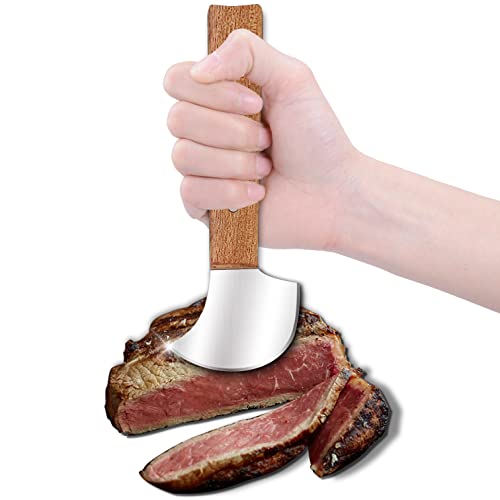
Fstcrt rocker knife with vertical wooden handle
Rocker knife
$19.99 price as of Sep 27, 2026 at 4:47 pm ET
Check price on Amazon (opens new tab)- Why it works
- A small curved blade under a vertical wooden handle: you press down and rock, so food doesn't need holding with a fork; reviewers use it one-handed after a stroke and shoulder surgery.
- Who it won't suit
- It is compact (6.3 inches long, about 100 grams), so large roasts and tough crusts take a while, and the curved edge is sharp when you wash it.
What reviewers report
Reviewers cutting with one hand after a stroke or shoulder surgery, and others with severe arthritis, say the rocking blade does what a fork and knife used to need two hands for. — Our summary of customer reviews on Amazon · read the reviews (opens new tab)

KAYCROWN ulu rocker knife with stand
Rocker knife
$13.99 price as of Sep 27, 2026 at 4:47 pm ET
Check price on Amazon (opens new tab)- Why it works
- A crescent-shaped blade you rock through food, so nothing has to be held still with a second hand; a reviewer's mother who survived a stroke uses it daily.
- Who it won't suit
- Not for a household with small children or anyone unsteady on their feet: it is a large open blade stored on a stand, not in a cover. Reviewers used it one-handed, not with a weak grip.
What reviewers report
Two reviews, both from people buying for someone else: a mother who had a stroke and uses it daily, and a friend whose shoulder was immobilized after surgery. — Our summary of customer reviews on Amazon · read the reviews (opens new tab)

YPCBYNBS T-Grip Rocker Knife,Adaptive Knife with Rocking Grip for…
Rocker knife
$9.49 price as of Sep 27, 2026 at 4:47 pm ET
Check price on Amazon (opens new tab)- Why it works
- The T-shaped handle sits inside a closed fist, so the arm rocks the 4-inch blade through food instead of the wrist sawing, and a single hand completes the cut.
- Who it won't suit
- Buyers with severe arthritis called the handle uncomfortable to hold for long, and one found the blade duller on arrival than the listing suggests.
What reviewers report
Reviewers cutting with one hand after a stroke, a cast or torn tendons say the rocking blade works for them. Those with severe arthritis are split: one found the handle uncomfortable and the blade less sharp than expected. — Our summary of customer reviews on Amazon · read the reviews (opens new tab)
Guides where we recommend rocker knives
Questions people ask about rocker knives
Can you cut steak with a rocker knife?
Yes, if the edge is sharp. Tender steak and chicken cut with a few rocks; tough or gristly meat takes many more and shows up a blunt blade quickly. Cutting thin strips rather than big chunks helps, because the blade has less to get through each time.
How do you use a rocker knife with one hand?
Set the middle of the blade on the food, press down, and roll the blade from tip to heel and back until you're through. Don't saw; the steady pressure is what holds the food in place. A non-slip mat under the plate stops the plate itself from sliding while you press.
What's the difference between a rocker knife and an ulu?
They cut the same way. An ulu is a traditional Inuit knife with a crescent blade and a handle centered above it, and it's usually used on a cutting board. Table rocker knives have a straight handle and a smaller blade meant for cutting food on a plate. With a weak grip, the ulu-style handle is often easier, because you push with your palm instead of holding on with your fingers.
Can you cut bread with a rocker knife?
Not well. A rocker knife presses down, so a soft loaf flattens before it cuts. It's fine for halving a sandwich or a slice of toast, but for a whole loaf, buying it pre-sliced is the simpler answer.