How to eat a meal with a weak grip
Quick answer: The problem is usually the knife, not the fork. A rocker knife cuts with a press and a roll of the arm instead of a sawing wrist, so the grip only has to hold, not pull. For the fork and spoon, fat foam tubing over the handles you already own does most of the work of adaptive cutlery for a few dollars.
A meal asks two different things of a weak hand. Cutting is the hard one: a straight knife needs a firm pinch on a thin handle and a back-and-forth saw, and both the pinch and the sawing come from the small muscles that arthritis, neuropathy and tendon damage take first. Lifting food is easier but longer — a fork is light, yet holding it through a whole meal is a sustained grip, and fingers that can manage the first few mouthfuls often give out before the plate is clear. The result is people who can start a meal but not finish it, or who order what does not need cutting.
Try this first (no purchase)
- Ask for it cut in the kitchen. At home, cutting the whole plate before you sit down turns the meal into fork work. In a restaurant, asking for a dish to come cut is a normal request and most kitchens do it without comment.
- Wrap the handle in a face cloth and an elastic band. A flannel wound round a fork handle and banded in place builds it up to roughly the thickness that foam tubing gives you. It is ugly and it works, and it tells you whether a fatter handle is actually your answer.
- Choose the plate, not the tool. Food that needs no knife — casseroles, fish, pasta, anything slow-cooked — removes the hardest part of the meal entirely, and a plate with a raised rim lets you push food onto the fork instead of chasing it.
- Rest your elbow on the table. Bringing the plate closer and propping the forearm turns a whole-arm lift into a wrist movement, which lasts far longer when strength is the limit.
- Eat the hard part first. Grip fades through a meal. Whatever needs cutting is easiest in the first five minutes, and leaving it until last is why so many meals end unfinished.
What actually helps
We may earn a commission when you buy through these links. It never decides what we list — see how we choose. Not a fit? Amazon takes most items back within 30 days; check the listing, since some personal-care items can't be returned.
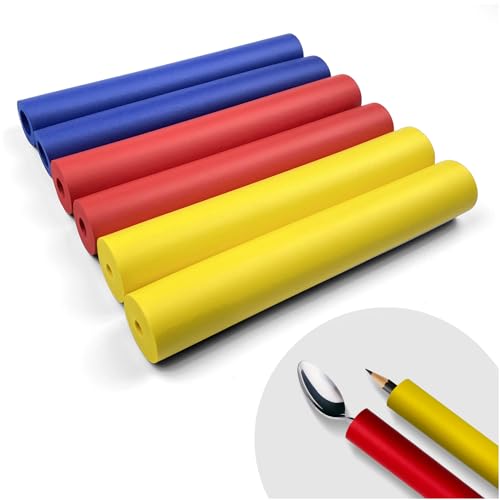
Our pick
Foam grip tubing, 6 pieces in 3 bore sizes
Foam grip tubing
$9.99 price as of Sep 27, 2026 at 4:47 pm ET
Check price on Amazon (opens new tab)- Why it works
- Slide an 8-inch foam tube over a pen, fork or toothbrush to build its handle up to 1.18 inches across, so fingers needn't close tightly; a reviewer uses them in therapy sessions.
- Who it won't suit
- You cut the tubes to length yourself, which one reviewer points out is a lot to ask of someone with arthritis, so someone else may need to do the cutting.
What reviewers report
A therapist reports using them in sessions with clients who have very little grip, and a wife uses them for fingers cramped by Parkinson's. One reviewer objects that you have to cut the tubing to length yourself. — Our summary of customer reviews on Amazon · read the reviews (opens new tab)

Cheaper option
YPCBYNBS T-Grip Rocker Knife,Adaptive Knife with Rocking Grip for…
Rocker knife · how to choose a rocker knife
$9.49 price as of Sep 27, 2026 at 4:47 pm ET
Check price on Amazon (opens new tab)- Why it works
- At the table the fist grip matters more than the blade: you hold the handle the way you hold a walking stick, and the arm supplies the press that tired fingers cannot.
- Who it won't suit
- Through a long meal the hard plastic T bites into the palm, and buyers with severe arthritis said it grew uncomfortable before they had finished.
What reviewers report
Reviewers cutting with one hand after a stroke, a cast or torn tendons say the rocking blade works for them. Those with severe arthritis are split: one found the handle uncomfortable and the blade less sharp than expected. — Our summary of customer reviews on Amazon · read the reviews (opens new tab)
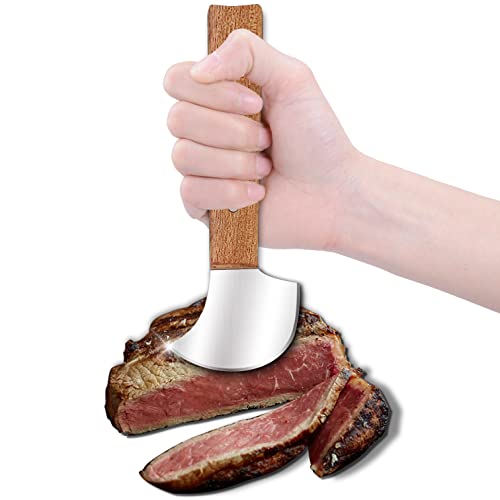
Another option
Fstcrt rocker knife with vertical wooden handle
Rocker knife · how to choose a rocker knife
$19.99 price as of Sep 27, 2026 at 4:47 pm ET
Check price on Amazon (opens new tab)- Why it works
- Short enough to leave beside the plate, so the one awkward item on the meal gets dealt with as you reach it rather than before you sit down.
- Who it won't suit
- A 6.3-inch blade suits a plate, not a roast, and the curve means you are washing a sharp edge you cannot see the whole of.
What reviewers report
Reviewers cutting with one hand after a stroke or shoulder surgery, and others with severe arthritis, say the rocking blade does what a fork and knife used to need two hands for. — Our summary of customer reviews on Amazon · read the reviews (opens new tab)
What not to buy for eating with a weak grip
- Weighted cutlery bought for a weak grip — the weight is there to steady a tremor, and it is the wrong fix here: heavier tools tire a weak hand faster. Check which problem a set is sold for before buying it.
- Knives with a thin ergonomic bulge halfway down the handle — the shaping looks adaptive but the grip is still a pinch, and the bulge suits one hand size. The gain over an ordinary knife is small enough that people stop using them.
- Full adaptive cutlery sets — a set buys you a knife, fork, spoon and often a teaspoon, when the knife is usually the only piece that was stopping you. Buy the knife, try it for a week, and add the rest only if the fork turns out to be a problem too.
Buying this for someone else?
Check these before you order:
- How far their fingers close. Watch them hold a mug or a hairbrush. If the fingers don't wrap all the way round, a thicker handle matters more than any other feature.
- Which movement is the problem. Twisting (lids, keys, taps), squeezing (scissors, spray bottles) and pinching (ring pulls, pill caps) call for different tools. Ask which jobs they put off, not only which ones hurt.
- How much weight is comfortable. Something that feels light in your hand can be too heavy for them over a whole meal or a page of writing. Compare the listed weight with a tool they already use every day.
- Left or right hand. Many can openers, scissors and some knives are made for right-handed use.
- What's already in the drawer. Ask what they have tried and why it didn't stick, so you don't buy the same thing twice.